Thursday, April 02, 2020

Sunday, August 27, 2017
We're all okay here.
Soggy and going to get soggier, but on high ground and not in danger of being flooded out.
I've had a number of emails from folks overseas, which is why I'm posting this.
The area of flooding is HUGE--as in, it would take the better part of a day (nine hours) to drive around the perimeter--but conditions vary widely. The majority of downtown Houston is toast, as are smaller towns northwest of it. A number of riverside towns in Central Texas are preparing for the worst as Harvey stalls out and rotates over us.
But again, we're all fine here.
If you have five bucks or two Euros or three Kroner, please consider donating to the Red Cross. If you don't have it now, you can donate in six weeks or six months and it'll do just as much good. The estimate for cleanup in the Houston area is somewhere in the neighborhood of 2+ YEARS at this point--and we're not even halfway through the rain event.
Thanks for caring, y'all. We'll get through this, even if we do it on a rubber raft shaped like a huge duck.
I've had a number of emails from folks overseas, which is why I'm posting this.
The area of flooding is HUGE--as in, it would take the better part of a day (nine hours) to drive around the perimeter--but conditions vary widely. The majority of downtown Houston is toast, as are smaller towns northwest of it. A number of riverside towns in Central Texas are preparing for the worst as Harvey stalls out and rotates over us.
But again, we're all fine here.
If you have five bucks or two Euros or three Kroner, please consider donating to the Red Cross. If you don't have it now, you can donate in six weeks or six months and it'll do just as much good. The estimate for cleanup in the Houston area is somewhere in the neighborhood of 2+ YEARS at this point--and we're not even halfway through the rain event.
Thanks for caring, y'all. We'll get through this, even if we do it on a rubber raft shaped like a huge duck.
Friday, November 25, 2016
Say goodnight, Gracie.
Ladies and germs, I have worked my last shift at Sunnydale Hospital (Healthcare for the Hellmouth)(Fully-owned and operated subsidiary of Giganto Research and Education Corp., Inc., LLP).
I start a few days from now at a very posh and very private surgical center, doing pre-op and post-op stuff. It was time. It was, honestly, past time.
In the past couple of years, Kitty and Bethie and I have busted our asses to get and then maintain certification. Sunnydale just got magnet status. We've earned five stars from whatever group it is that rates patient care that way. We've earned gold medals from the folks who figure out how many patients you have die, or come back, or otherwise not do well. We have, with our coworkers, rocked it. Our unit is the highest-rated unit in the system, in terms of safety and success and patient satisfaction.
And in return, we got staff cuts. Bethie got accused by a crazy family of abusing a patient and was left to dry in the sun by Manglement; she spent two days on her own dealing with detectives and forensics teams and lawyers and so on without a peep from her bosses. And when Kitty and I went to those bosses on her behalf, we got promises and no action.
So, yeah. It was time.
In a way, my fourteen years at Sunnydale remind me a lot of my marriage: Erstwhile Hub and I had a number of really good years, but then he began a slow slide into insanity. That culminated in something so bad, so unforgivable, so weird, that I had to walk away.
I've spent the last two weeks wondering how on earth I'm going to say goodbye to all these people. The people at my work got me through a divorce and took care of me after Dr. Heron cut the roof of my mouth out and sent it to Pathology. I've been the funeral of a coworker--it was possible because nurses from all over the hospital came in on their days off and moved down the hall in a flying wedge that allowed all of us to pass on care for a couple of hours. I've been to funerals for husbands and wives and daughters and sons. I've also gotten birth announcements and wedding invitations and innumerable emails and Facebook messages from patients and coworkers, letting me share in tiny good and tiny bad things. I've cooked Thanksgiving feasts and had a couple of surprise birthday parties.
You hear a lot of businesses say, "Our employees are family," but in this case it's true. Above my immediate manager is nobody I'd piss on if they were on fire, but below that? Lidia and Carolita and Edgar and James and Lisa and all those other folks are my family.
James made the comment the other day that he and I are the longest relationship he's ever had. He was the one who looked up my NCLEX score to see if I'd passed, back on the third day of our internship together, because I was too afraid to.
I spent days and days going to every department in turn, repeatedly, and I'm sure I still missed people. I'll visit, sure, but it won't be the same. And we're all pals on Facebook, but it won't be the same. Saying goodbye was hard.
And saying goodbye to you guys won't be any easier.
I'm shutting down HN. Let's be honest: "Preop-and-PACU-Nurse" just doesn't have the ring that "Head Nurse" does. I've done brains for so long that the thought of switching to something else is a little scary. Maybe someday later I'll have more stories to tell, those about healthy people getting elective surgeries and my taking care of them for two hours. For now, though, this is a good break. It's a period at the end of a long, amazing, convoluted sentence that any Restoration author would be proud of.
Because you know what you did? You, the idiots who keep checking in on HN, did this:
You kept me sane during times that I had nothing left. You got me through working nights, through having cancer, through a nasty breakup, through periods of self-doubt that encompassed not only my work but my self.
You emailed me with questions and criticisms and reflections that made me think hard about my life and sometimes go back and edit things here.
You bought two enormously expensive therapeutic jaw-stretcher dealios for people who couldn't afford them, thus allowing any number of people (because the devices were sanitized and passed around) to be able to do things like brush their teeth and eat after cancer surgery.
You contributed a thousand dollars to the Oral Cancer Foundation, because you cared about what I'd been through.
And you all, because you were generous enough to let me siphon off money you'd donated for a friend in need, made it possible for my friends Kevin and Sarah to stay in their apartment during the last weeks of Kevin's life. You paid their rent and electricity bills, and because of that, Kevin got to watch one last episode of "Doctor Who" with Sarah before the brain tumor he had rendered him unconscious.
Most of all, though, you responded to what I wrote here and made it better. There were a lot of times I thought I was writing into a void, and you told me that wasn't the case. I've said a lot of stupid shit and been called on it, and once in a while I've said something here that seemed to resonate with people, and that's made me think that maybe the world is pretty cool after all.
The money was great, because it accomplished tangible things.
The love and support and feedback and sometimes outright rage has been infinitely more valuable.
Thank you for wasting time here. May your pumps always have full batteries and your ventriculostomies always be level.
I start a few days from now at a very posh and very private surgical center, doing pre-op and post-op stuff. It was time. It was, honestly, past time.
In the past couple of years, Kitty and Bethie and I have busted our asses to get and then maintain certification. Sunnydale just got magnet status. We've earned five stars from whatever group it is that rates patient care that way. We've earned gold medals from the folks who figure out how many patients you have die, or come back, or otherwise not do well. We have, with our coworkers, rocked it. Our unit is the highest-rated unit in the system, in terms of safety and success and patient satisfaction.
And in return, we got staff cuts. Bethie got accused by a crazy family of abusing a patient and was left to dry in the sun by Manglement; she spent two days on her own dealing with detectives and forensics teams and lawyers and so on without a peep from her bosses. And when Kitty and I went to those bosses on her behalf, we got promises and no action.
So, yeah. It was time.
In a way, my fourteen years at Sunnydale remind me a lot of my marriage: Erstwhile Hub and I had a number of really good years, but then he began a slow slide into insanity. That culminated in something so bad, so unforgivable, so weird, that I had to walk away.
I've spent the last two weeks wondering how on earth I'm going to say goodbye to all these people. The people at my work got me through a divorce and took care of me after Dr. Heron cut the roof of my mouth out and sent it to Pathology. I've been the funeral of a coworker--it was possible because nurses from all over the hospital came in on their days off and moved down the hall in a flying wedge that allowed all of us to pass on care for a couple of hours. I've been to funerals for husbands and wives and daughters and sons. I've also gotten birth announcements and wedding invitations and innumerable emails and Facebook messages from patients and coworkers, letting me share in tiny good and tiny bad things. I've cooked Thanksgiving feasts and had a couple of surprise birthday parties.
You hear a lot of businesses say, "Our employees are family," but in this case it's true. Above my immediate manager is nobody I'd piss on if they were on fire, but below that? Lidia and Carolita and Edgar and James and Lisa and all those other folks are my family.
James made the comment the other day that he and I are the longest relationship he's ever had. He was the one who looked up my NCLEX score to see if I'd passed, back on the third day of our internship together, because I was too afraid to.
I spent days and days going to every department in turn, repeatedly, and I'm sure I still missed people. I'll visit, sure, but it won't be the same. And we're all pals on Facebook, but it won't be the same. Saying goodbye was hard.
And saying goodbye to you guys won't be any easier.
I'm shutting down HN. Let's be honest: "Preop-and-PACU-Nurse" just doesn't have the ring that "Head Nurse" does. I've done brains for so long that the thought of switching to something else is a little scary. Maybe someday later I'll have more stories to tell, those about healthy people getting elective surgeries and my taking care of them for two hours. For now, though, this is a good break. It's a period at the end of a long, amazing, convoluted sentence that any Restoration author would be proud of.
Because you know what you did? You, the idiots who keep checking in on HN, did this:
You kept me sane during times that I had nothing left. You got me through working nights, through having cancer, through a nasty breakup, through periods of self-doubt that encompassed not only my work but my self.
You emailed me with questions and criticisms and reflections that made me think hard about my life and sometimes go back and edit things here.
You bought two enormously expensive therapeutic jaw-stretcher dealios for people who couldn't afford them, thus allowing any number of people (because the devices were sanitized and passed around) to be able to do things like brush their teeth and eat after cancer surgery.
You contributed a thousand dollars to the Oral Cancer Foundation, because you cared about what I'd been through.
And you all, because you were generous enough to let me siphon off money you'd donated for a friend in need, made it possible for my friends Kevin and Sarah to stay in their apartment during the last weeks of Kevin's life. You paid their rent and electricity bills, and because of that, Kevin got to watch one last episode of "Doctor Who" with Sarah before the brain tumor he had rendered him unconscious.
Most of all, though, you responded to what I wrote here and made it better. There were a lot of times I thought I was writing into a void, and you told me that wasn't the case. I've said a lot of stupid shit and been called on it, and once in a while I've said something here that seemed to resonate with people, and that's made me think that maybe the world is pretty cool after all.
The money was great, because it accomplished tangible things.
The love and support and feedback and sometimes outright rage has been infinitely more valuable.
Thank you for wasting time here. May your pumps always have full batteries and your ventriculostomies always be level.
Wednesday, November 23, 2016
Once upon a time, there was a nurse named
Carol. Or Marcie. Or Kristen. Or Justin. Or Brandon. Or John. Or Tita. Or Lidia. Or David. Or Aimee.
And that nurse taught me everything I ever needed to know about IV starts. Or dealing with difficult patients. Or dealing with difficult coworkers. Or handling death. Or handling survival. Or just surviving a shift.
Once upon a time, there was a unit secretary named Harriet. Or Girlie. Or Mary. Or Joanna. Or Marlene.
And that unit secretary taught me everything I know about finding the answers to tricky problems. Or about who to call when something breaks. Or about who to call when nobody else can fix something. Or about how to MacGyver something when nobody's around.
Once upon a time, there was a housekeeper named Shirley. Or Larry. Or Lisa. Or Gary. Or Richard. Or Daphne.
And they taught me how to put the bag into the trashcan so it didn't fall down halfway through the shift. And how to get that weird stain out of my patient's pajamas, and who to call when I needed a lightbulb, and how to fix the drain in 18 when it just would not drain.
Once upon a time there was a biomed guy, or a maintenance guy, or a woman from food service, or some person from the concierge.
And even if I didn't get their name at the time, they taught me how to avert disaster by either rebooting some monitor somewhere by doing some obscure Ancient Technology dance, or they helped me manage somebody's diet when they were about to order out for KFC, or they brought me the paper some family member was yelling for with a minute's warning.
Once upon a time there were patients: sick people, or people who only had one thing wrong with them, or people who were just plain old, or people who were far, far too young to deal with the things that they had to deal with.
And they taught me about being decent, and patient, and having humor even when you look like a goblin and things fucking suck, and loving yellow flowers and always wearing pearls, and not flipping out when you have a downturn in your diagnosis, and finally, living and dying the way you want to, with dignity and humor.
For all those people I give thanks.
And that nurse taught me everything I ever needed to know about IV starts. Or dealing with difficult patients. Or dealing with difficult coworkers. Or handling death. Or handling survival. Or just surviving a shift.
Once upon a time, there was a unit secretary named Harriet. Or Girlie. Or Mary. Or Joanna. Or Marlene.
And that unit secretary taught me everything I know about finding the answers to tricky problems. Or about who to call when something breaks. Or about who to call when nobody else can fix something. Or about how to MacGyver something when nobody's around.
Once upon a time, there was a housekeeper named Shirley. Or Larry. Or Lisa. Or Gary. Or Richard. Or Daphne.
And they taught me how to put the bag into the trashcan so it didn't fall down halfway through the shift. And how to get that weird stain out of my patient's pajamas, and who to call when I needed a lightbulb, and how to fix the drain in 18 when it just would not drain.
Once upon a time there was a biomed guy, or a maintenance guy, or a woman from food service, or some person from the concierge.
And even if I didn't get their name at the time, they taught me how to avert disaster by either rebooting some monitor somewhere by doing some obscure Ancient Technology dance, or they helped me manage somebody's diet when they were about to order out for KFC, or they brought me the paper some family member was yelling for with a minute's warning.
Once upon a time there were patients: sick people, or people who only had one thing wrong with them, or people who were just plain old, or people who were far, far too young to deal with the things that they had to deal with.
And they taught me about being decent, and patient, and having humor even when you look like a goblin and things fucking suck, and loving yellow flowers and always wearing pearls, and not flipping out when you have a downturn in your diagnosis, and finally, living and dying the way you want to, with dignity and humor.
For all those people I give thanks.
Monday, October 24, 2016
What happens when. . . .
. . . .you drive hours and hours and hours and HOURS to the State Fair of Texas with four of your colleagues, one of whom is Filipina, one of whom is from Houston, one of whom is from Minnesota, and the last of whom is from the Texas valley, and you introduce them to (variously) corny dogs, fried cheese curds, and the concept of beer before noon?
You learn that it's not a touch of nature that makes the whole world kin. It's fried cheese curds. (The girl from Minnesota was practically in tears to find her native cuisine featured at the Fair.)
. . . .your coworker says, as you're giving report, "Oh, come on. It's not that hard to charge on three units at once!"
You do this:
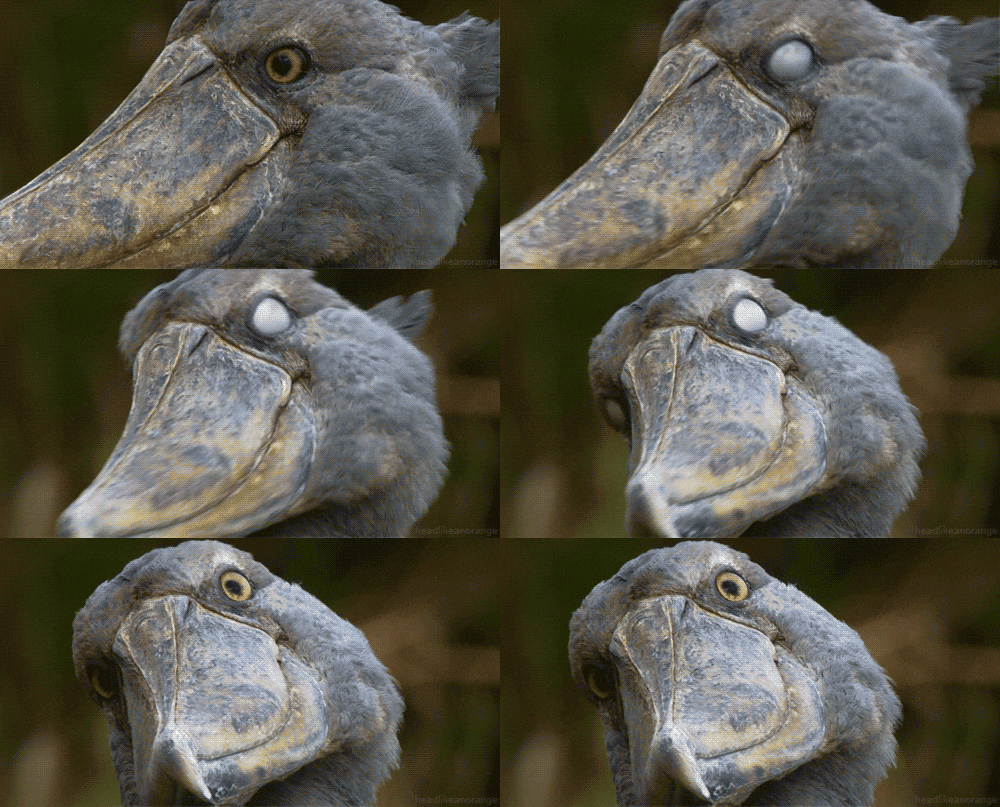
This .gif so perfectly encompasses so many of my life situations that I feel strongly I must've been a shoebill in a past life.
. . . .you realize upon waking up that you're on the first day of three weeks' vacation?

You learn that it's not a touch of nature that makes the whole world kin. It's fried cheese curds. (The girl from Minnesota was practically in tears to find her native cuisine featured at the Fair.)
. . . .your coworker says, as you're giving report, "Oh, come on. It's not that hard to charge on three units at once!"
You do this:
This .gif so perfectly encompasses so many of my life situations that I feel strongly I must've been a shoebill in a past life.
. . . .you realize upon waking up that you're on the first day of three weeks' vacation?
Friday, October 07, 2016
History.
"Are you on any medications at home?" I asked. He was in for a swollen wrist--and I mean a swollen. wrist. The thing looked like he had a half a softball in there.
"Nope. Nothing."
"What about for the pain in your wrist?"
"Oh, yeah, I mean, I take Tramadol for that."
"Okay. So. . . .anything for high blood pressure, anything like that?"
"No."
Okay. On to the next question. I know this one will be fun because he's got dozens of missed follow-ups and lit up his last utox like a Christmas tree. Two weeks ago.
"Any street drugs? Heroin? Cocaine? Weed?"
"Why you motherfuckers always askin' me about street drugs? I don't do no drugs! I don't smoke weed or shoot heroin or nothin'! What the fuck are you people goin' on about drugs? I never done no drugs! (random profanity)(random tossing things around the room)(stomping)(breathing heavily)"
"So all you take at home is Tramadol for your wrist?"
"Yeah. And Suboxone."
"Nope. Nothing."
"What about for the pain in your wrist?"
"Oh, yeah, I mean, I take Tramadol for that."
"Okay. So. . . .anything for high blood pressure, anything like that?"
"No."
Okay. On to the next question. I know this one will be fun because he's got dozens of missed follow-ups and lit up his last utox like a Christmas tree. Two weeks ago.
"Any street drugs? Heroin? Cocaine? Weed?"
"Why you motherfuckers always askin' me about street drugs? I don't do no drugs! I don't smoke weed or shoot heroin or nothin'! What the fuck are you people goin' on about drugs? I never done no drugs! (random profanity)(random tossing things around the room)(stomping)(breathing heavily)"
"So all you take at home is Tramadol for your wrist?"
"Yeah. And Suboxone."
Thursday, October 06, 2016
Lieutenant Lumpy: An Update.
Another year, another clean set of scans and a pristine checkup with Dr. Crane and his Irrepressibly Cheerful Staff. (They always seem happy to see me? I guess because I don't look like Frankenstein's Monster?)
Next year, because the lung nodule I have has not changed in six years, I can start getting annual chest x-rays rather than an annual chest CT, along with my usual head/neck/orbits MR. I'll have to get all that every year for the foreseeable future, because (as Dr. Crane said), "These stupid salivary gland tumors have a really long fuse." And they tend to recur in both the original spot and met to really weird places.
Still, I'm happy. I didn't have to have radiation, I'm functional with The Bug, and I've discovered (and am still discovering) benefits to having an obturator for a palate rather than factory equipment.
One of the most interesting side effects of having CANSUH has been my failing to give a shit about a number of things that used to be really important. I can't believe, for instance, that I worried so much about how I sounded and looked after surgery. I mean, it's understandable--the first obturator was barely better than my postsurgical mouth, and the second one, while an improvement, left a *lot* to be desired.
(If I had it to do over again, I'd go back and tell myself that 1) a year seems much longer than it actually is, and 2) to go ahead and buy a Therabite prior to surgery, rather than waiting however many weeks I waited.)
I also Don't Really Care any longer about what people think about things I might decide to do. For instance, the headliner in my car is coming down. I'm going to repair it with these little twisty screw pin things, then cover the heads of the pins with little glow-in-the-dark stars. This is a good idea. I like this idea. Other people think it's a weird idea.
And SBAR. SBAR is a communication technique developed by the Navy and figured out independently by a number of smart people in other fields, and works like this:
In oral communication, it's important to get to the gist of what you're dealing with, explain the background in a few words, give your opinion of the problem, and suggest a solution. It's what we do, by instinct, when we call doctors for (say) medication orders for nausea:
"I'm taking care of Ms. Smith in 918. She's post-angio day two and has had intractable nausea and vomiting for the last eight hours. I've given her Zofran and Tigan, but it hasn't helped. She's currently not making a lot of urine, but has no IV fluids. Can I start gentle rehydration at 75 an hour and give her a dose of Decadron?"
It works great for oral communication. It sucks for written communication.
Which is why the Powers That Be at Sunnydale have decided that the nurses will now write an SBAR summary of their shifts, every shift, and include it in the shift notes.
SBAR is meant to be a crisis communication, or give information in the case of rounding or reporting. It's not meant to sum up an entire shift. Trying to chivvy a summation of what you did into a shift into SBAR form is just. Fucking. Stupid. The suggestion from TPTB is that we focus on the problem that occupied "80% of the shift," but come on: most nurses, even those with only three patients, have multiple problems to solve that occupy about 20% of each shift per problem.
It's a bad use of a really good tool.
So I wrote my SBAR reports in limerick form this week.
Situation: Ms. S is not making much pee;
We wonder just why that might be.
We think that she's dry
And the prime reason why
Is that she's in need of IVs.
Background: She suffered a stroke yesterday
For which she received TPA.
She's had bad reactions
To some medications (approximate rhyme; sorry)
And so she is barfing today.
Assessment: Lethargic, unhappy, and sore
With pulse running 144,
And 80 systolic
Abdominal colic
And puddles of gark on the floor.
Recommendation: Hydration is our biggest worry
'Cause she's gotten dry in a hurry.
To prevent AKI,
We really should try
To top her up *fast*, Dr. Curry. [had to change the MD's name to anonymize]
Next week, it'll be haiku. Nobody reads my damn notes anyhow, so I don't really care what anybody thinks of them.
Next year, because the lung nodule I have has not changed in six years, I can start getting annual chest x-rays rather than an annual chest CT, along with my usual head/neck/orbits MR. I'll have to get all that every year for the foreseeable future, because (as Dr. Crane said), "These stupid salivary gland tumors have a really long fuse." And they tend to recur in both the original spot and met to really weird places.
Still, I'm happy. I didn't have to have radiation, I'm functional with The Bug, and I've discovered (and am still discovering) benefits to having an obturator for a palate rather than factory equipment.
One of the most interesting side effects of having CANSUH has been my failing to give a shit about a number of things that used to be really important. I can't believe, for instance, that I worried so much about how I sounded and looked after surgery. I mean, it's understandable--the first obturator was barely better than my postsurgical mouth, and the second one, while an improvement, left a *lot* to be desired.
(If I had it to do over again, I'd go back and tell myself that 1) a year seems much longer than it actually is, and 2) to go ahead and buy a Therabite prior to surgery, rather than waiting however many weeks I waited.)
I also Don't Really Care any longer about what people think about things I might decide to do. For instance, the headliner in my car is coming down. I'm going to repair it with these little twisty screw pin things, then cover the heads of the pins with little glow-in-the-dark stars. This is a good idea. I like this idea. Other people think it's a weird idea.
And SBAR. SBAR is a communication technique developed by the Navy and figured out independently by a number of smart people in other fields, and works like this:
In oral communication, it's important to get to the gist of what you're dealing with, explain the background in a few words, give your opinion of the problem, and suggest a solution. It's what we do, by instinct, when we call doctors for (say) medication orders for nausea:
"I'm taking care of Ms. Smith in 918. She's post-angio day two and has had intractable nausea and vomiting for the last eight hours. I've given her Zofran and Tigan, but it hasn't helped. She's currently not making a lot of urine, but has no IV fluids. Can I start gentle rehydration at 75 an hour and give her a dose of Decadron?"
It works great for oral communication. It sucks for written communication.
Which is why the Powers That Be at Sunnydale have decided that the nurses will now write an SBAR summary of their shifts, every shift, and include it in the shift notes.
SBAR is meant to be a crisis communication, or give information in the case of rounding or reporting. It's not meant to sum up an entire shift. Trying to chivvy a summation of what you did into a shift into SBAR form is just. Fucking. Stupid. The suggestion from TPTB is that we focus on the problem that occupied "80% of the shift," but come on: most nurses, even those with only three patients, have multiple problems to solve that occupy about 20% of each shift per problem.
It's a bad use of a really good tool.
So I wrote my SBAR reports in limerick form this week.
Situation: Ms. S is not making much pee;
We wonder just why that might be.
We think that she's dry
And the prime reason why
Is that she's in need of IVs.
Background: She suffered a stroke yesterday
For which she received TPA.
She's had bad reactions
To some medications (approximate rhyme; sorry)
And so she is barfing today.
Assessment: Lethargic, unhappy, and sore
With pulse running 144,
And 80 systolic
Abdominal colic
And puddles of gark on the floor.
Recommendation: Hydration is our biggest worry
'Cause she's gotten dry in a hurry.
To prevent AKI,
We really should try
To top her up *fast*, Dr. Curry. [had to change the MD's name to anonymize]
Next week, it'll be haiku. Nobody reads my damn notes anyhow, so I don't really care what anybody thinks of them.
Subscribe to:
Posts (Atom)
